
Application Notes
Battery Storage Is Learning to See Thermal Runaway Coming: Temperature and Pressure Monitoring in BESS
Battery storage safety is shifting from fire suppression to early warning: immersion cooling, in-cell temperature-pressure sensing and BMS-linked protection now aim to spot thermal runaway weeks ahead.
A battery energy storage system is a lot of energy in a small, sealed box — and its worst failure, thermal runaway, starts quietly. One cell gets hotter than its neighbours, its temperature climbs, it vents gas, and the heat spreads to the next cell. By the time smoke or flame is visible, the event is already running. That is why 2026 has become the year storage safety stopped being mainly about suppression and started being about seeing the failure coming: more temperature points, pressure watching, and cooling that removes heat before it can spread.
The numbers behind the shift
The clearest signal came at The smarter E Europe 2026 in Munich, where Desay Battery showed a static immersion-cooling system for storage cells together with a proactive safety management system. The cells sit in an insulating liquid that blocks the heat path between them; if a cell does go into runaway, the liquid carries heat away and cuts off oxygen contact. More important than the liquid itself is what is inside the system: temperature and pressure sensors embedded in the cells, millisecond-level multi-parameter monitoring, and intelligent early warning. Desay's claim for the system is a 30-day advance warning of thermal runaway risk — a shift from reacting to a fire to acting on a slow drift weeks before it becomes one.
Temperature is the earliest signal
Thermal runaway is, at its root, a temperature story. A failing cell heats up before it vents, before its voltage collapses, and long before smoke appears. That makes temperature the earliest measurable warning — but only if the sensors are in the right places and fast enough to matter:
- Cell-level temperature — NTC thermistors sit close to the cells and react quickly to a local hot spot, which is exactly where runaway starts. Their speed matters more than their absolute accuracy at this point in the chain.
- Pack and rack temperature — Pt100 probes watch coolant, air and busbar temperatures across the pack, where stability and interchangeability matter: a sensor that drifts a degree over years is a monitoring system that slowly learns to ignore a real rise.
- Coolant temperature and differential — in liquid-cooled packs, the difference between supply and return temperature shows whether heat is actually being removed. A narrowing differential means the cooling is losing capacity — or a cell is adding heat faster than the loop can take it away.
Pressure is the second witness
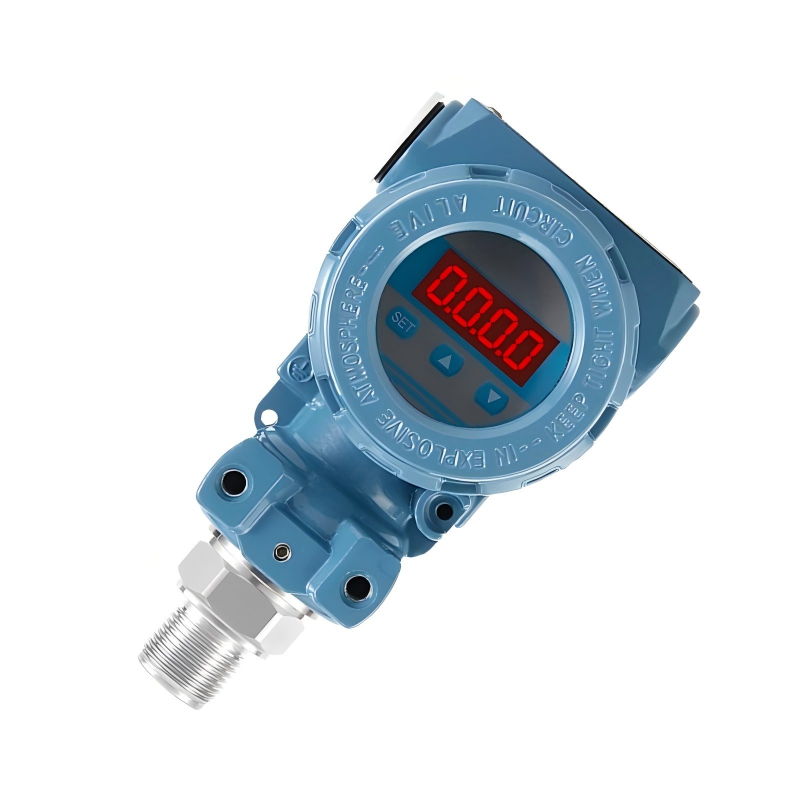
Temperature alone can be fooled by a sensor fault or a hot day. Pressure is the corroborating signal. When a cell vents, gas is released into a sealed pack or container, and pressure rises — often before visible smoke. A pressure transmitter on the pack or container watches that rise, and differential pressure across filters and coolant loops flags clogging and pump wear in the same way it does in any liquid loop. SolaX's AEGIS all-in-one storage system, launched in July 2026, builds this logic into the product: temperature sensors continuously monitor the system, the inverter and battery management system respond together to limit or shut down operation when an anomaly is detected, and if the condition persists or escalates, an integrated aerosol fire-suppression system activates. The wider safety package includes continuous battery monitoring, early-warning functions, an integrated circuit breaker and a pressure-relief channel.
Immersion cooling changes the job of the sensor
Immersion cooling — putting cells in direct contact with a dielectric liquid — is moving from electric vehicles into storage because it removes heat faster and more evenly than cold plates. But it changes what the sensors have to do. TotalEnergies Lubrifiants, which introduced its Coolant Keep Plate in October 2026, flagged the weak point honestly: when a cell vents, the gas jet can displace the dielectric fluid around the neighbouring cells, leaving them exposed just when they need cooling most. Its passive plate sits between the cell group and the venting interface, letting gas escape while keeping fluid around the most exposed cells — no sensors, no controls, no power.
The lesson for sensor selection is that immersion does not remove the need for measurement; it moves it. In-cell temperature and pressure sensing becomes the early-warning layer, while coolant temperature, pressure and flow monitoring becomes the proof that the cooling itself is still working. A system that watches both — the cells and the loop — can tell a load-driven thermal swing from a real fault, which is the difference between a false alarm and a warning that arrives in time.
What this means for sensor selection
For the people who build and operate storage systems, the sensing requirements are specific:
- Temperature points multiply, and they split by job. Fast NTC sensing at the cell for early hot-spot detection; stable Pt100 sensing at the pack, coolant and container level for trend monitoring over years of service.
- Pressure is a diagnostic, not just a reading. Pack pressure rise is an early venting signal; loop and differential pressure are the earliest indicators of coolant problems. A pressure transmitter that holds its zero over years is worth more than one with a slightly better datasheet number.
- The protocol is the product. Battery management systems and energy management platforms talk CAN, Modbus and RS485. A temperature transmitter module that outputs 4–20 mA or RS485/Modbus drops straight into that world; a sensor with no standard output does not.
- Retrofits are a real market. Existing containers are adding denser temperature and pressure monitoring around air-cooled equipment, and sensor retrofits can add cell, pack and coolant visibility without replacing the battery system.
Where the sensing goes
Storage safety is becoming a measurement problem with a deadline: spot the bad cell early, prove the cooling is working, and give the system time to act. Universal Ruike supplies the measurement points: NTC thermistors for fast cell-level temperature sensing, Pt100 probes in custom lengths and fittings for pack, coolant and container points, industrial pressure transmitters for pack pressure and coolant-loop pressure, and temperature transmitter modules with 4–20 mA and RS485 outputs for BMS integration. If you are building or retrofitting battery storage, tell us the cell and pack layout, the temperature and pressure range, and the protocol the controls expect — and we will match the sensor to it.
Related products: Ring Lug NTC Thermistor · Platinum Resistance Sensors · Industrial Pressure Transmitter · Temperature Transmitter Modules