
Selection Guides
RTD vs Thermocouple: How to Choose the Right Temperature Sensor
A practical engineer's comparison of RTDs (Pt100) and thermocouples: accuracy, temperature range, drift, response time, vibration, wiring and cost — with a simple decision rule for industrial applications.
RTDs and thermocouples are the two workhorses of industrial temperature measurement, and they fail, drift and install in completely different ways. Choosing between them is less about which is "better" and more about which one's limits your process hits first. Here is the comparison we walk through with customers, in the order that actually decides it.
1. Temperature range — the hard filter
If your process goes above roughly 600 °C, the decision is already made: use a thermocouple. Base-metal types such as K and N cover up to about 1200 °C, and noble-metal types (S, R, B) go higher still — furnaces, kilns, exhaust gas and heat treatment all live in thermocouple territory.
Platinum RTDs are normally rated −200…+600 °C, and in practice their accuracy classes are guaranteed over a narrower band (a Class A element is valid to +450 °C at best). Between −200 °C and +500 °C, both technologies are available and the remaining criteria decide.
2. Accuracy — the RTD's home ground
A Class A Pt100 deviates at most ±0.35 °C at 100 °C and ±0.55 °C at 200 °C (IEC 60751). A standard Type K thermocouple is specified at ±2.2 °C or ±0.75 % of reading, whichever is greater — at 500 °C that is ±3.75 °C. Even "special limits" thermocouple wire (±1.1 °C or ±0.4 %) stays several times looser than a Class A RTD.
If you control a pasteurization step, a chemical reaction or a quality-critical oven zone with a ±1–2 °C window, an RTD is usually the only economical way to hold it.
3. Stability and drift — what the reading looks like in year two
Platinum elements are chemically stable and drift very little when not abused — typically a fraction of a degree per year. Thermocouples drift more, especially in hot service: oxidation and internal metallurgical changes (Type K is known for this in the 200–600 °C band) shift the output along the hot part of the wire, and the drift can be hard to detect because it does not occur at the measuring junction alone. In practice, thermocouples in furnaces are treated as consumables with a replacement interval; RTDs are treated as instruments with a calibration interval.
4. Response time, vibration and construction
A thermocouple junction is tiny, so it responds fast and tolerates shock and vibration well — the default choice for engines, turbines and fast transients. An RTD element (especially wire-wound) is more delicate and a little slower; mineral-insulated constructions narrow the gap considerably. For very tight spaces, thin-film RTDs and fine-gauge thermocouples both work — check the minimum immersion length before assuming either.
5. Wiring and signal handling
- RTD: resistance measurement. Use a 3-wire connection (industrial standard) or 4-wire (laboratory accuracy) so lead resistance is compensated; a 2-wire Pt100 adds about 2.6 °C of error per ohm of lead resistance.
- Thermocouple: millivolt measurement. It needs matching extension wire all the way to the instrument and cold-junction compensation in the measuring device; copper patch cables in the run create false junctions and errors.
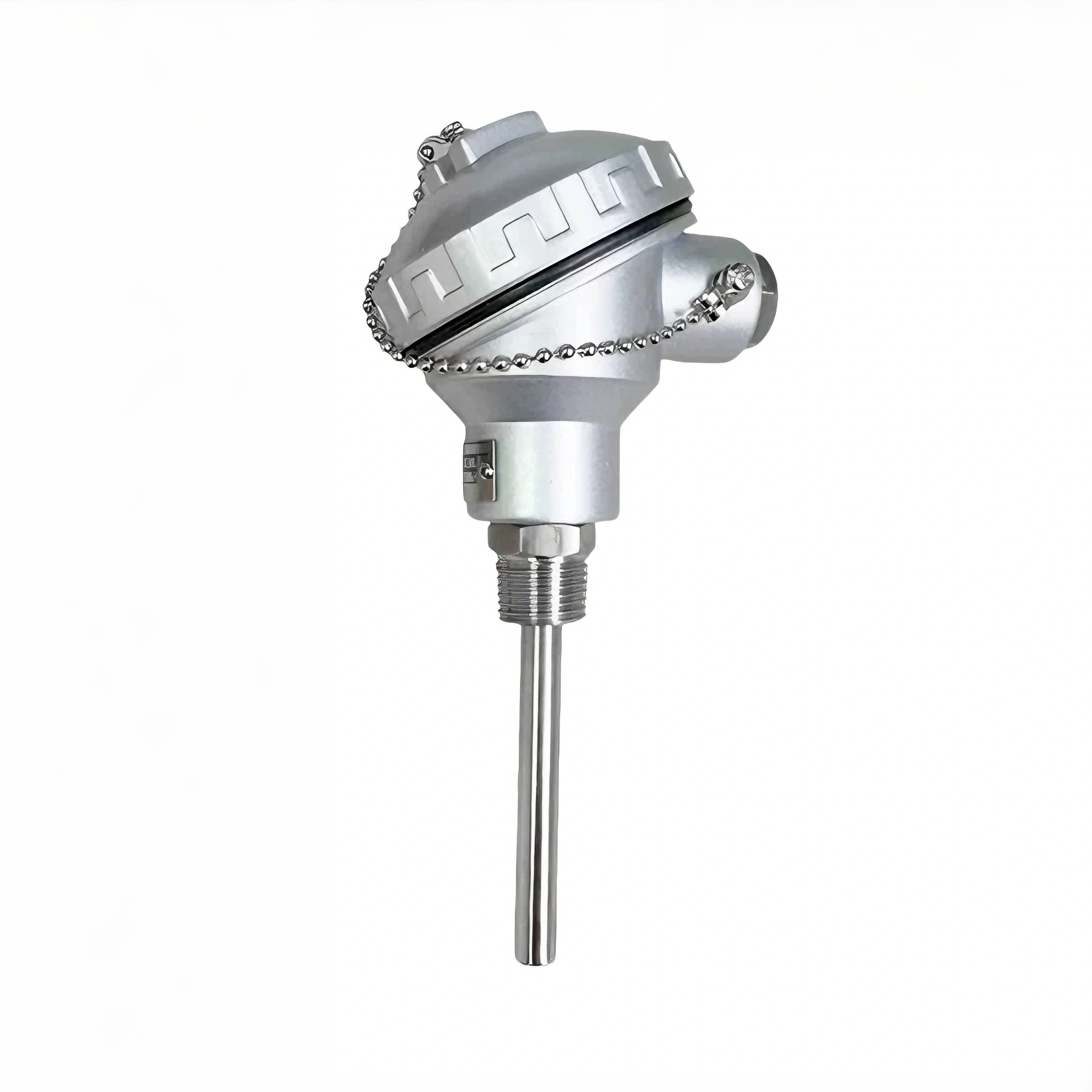
- In many plants, both sensor types feed a head-mounted temperature transmitter that converts the signal to 4–20 mA (optionally HART or RS485) at the point of measurement — this standardizes the run to the PLC and removes most wiring pitfalls on both sides.
6. Cost
Per point, a base-metal thermocouple is cheaper than an RTD assembly, and much cheaper at high temperatures. The RTD's higher purchase price is often recovered through longer service life and fewer recalibrations in the −200…+500 °C band.
The decision in one table
| Criterion | RTD (Pt100) | Thermocouple (K / N / J) |
|---|---|---|
| Practical range | −200 … +600 °C | −200 … +1200 °C and above |
| Best accuracy | ±0.10…0.35 °C (Class AA/A) | ±1.1…2.2 °C |
| Long-term drift | Very low | Noticeable in hot service |
| Response time | Seconds | Sub-second possible |
| Vibration tolerance | Moderate (better in MI construction) | High |
| Wiring | 3- or 4-wire, lead compensation | Extension wire + cold-junction compensation |
| Typical role | Precision control points | High heat, fast transients, consumable points |
Rule of thumb: below 500 °C, choose an RTD when accuracy and stability matter; above 600 °C, or where the sensor is a rugged consumable, choose a thermocouple. Many plants standardize on both — RTDs at quality-critical points, thermocouples in furnaces and exhaust streams.
Universal Ruike manufactures both: Pt100/RTD probes and thermocouple assemblies built to your length, sheath and connection spec, with head-mounted transmitters (4–20 mA / RS485 / HART) when you want a PLC-ready signal. Share your temperature range and accuracy target, and we will recommend which side of this table your application belongs on.
Related products: Thermocouple Sensors · Armored Platinum Resistance Thermometer (RTD) · Temperature Transmitter Modules